“The inner journey from inertia to ecstasy.”
— Gabrielle Roth
5Rhythms® conscious movement practice is structured around a sequence of qualities that map the natural rise and fall of energy. By following the unfolding of the rhythms the mover can become more present, process emotions and access altered mind-states.
The 5Rhythms® are: flowing, staccato, chaos, lyrical, and stillness, distinct stages that build on one another to create a sequence known as the wave™. Each rhythm has recognisable qualities, aligns with an element and life stage, and is associated with an emotional category. The practice supports exploration and transformation of the self through intuitive movement.
In movement we can loosen the grip of our habits and preconceptions – let go of who we think we are, and be more authentic, present and available for ourselves and others. We are all in process and the dance allows our process to unfold.
First class?
Some people like to dive straight in with no expectations and others can feel daunted. Either way, a little advance information can help.
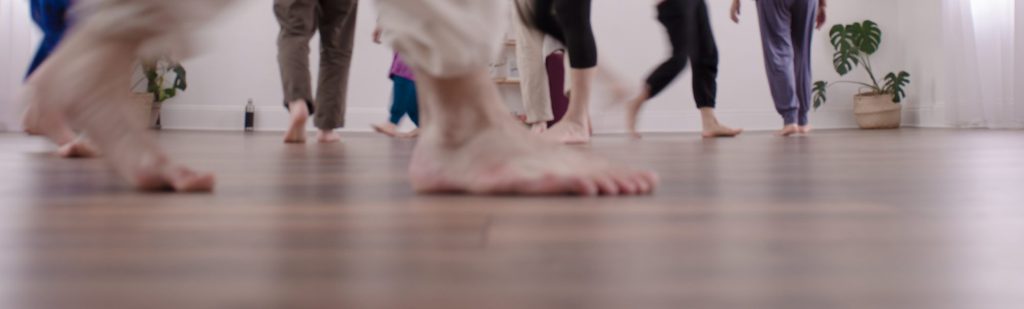
On a practical level it’s good to bring a water bottle and wear comfortable layers as there may be times when you will feel hot and others when you’ll want to wrap up warm. You can dance barefoot or in soft-soled dance shoes – for hygiene and safety there are no outdoor shoes in the dance space.
There might be warm-up music playing when you arrive. This is a time for loosening up on lots of levels. People often stretch, dance, or meditate – whatever they need to do to let go of their day and the journey to the class. You might be greeted by someone but other dancers may just carry on doing their own thing and pay little attention as you arrive.
You may be asked not to talk, as it keeps the mind busy and is distracting for other dancers. We often release nervous energy by chatting so this can feel uncomfortable for some people. If you’re not sure what to do, go and find the teacher or an assistant and let them know it’s your first time. They may suggest strategies to help you get grounded and quiet your mind, such as breath work or movement techniques.
You can find more info about the rhythms, common questions, and what to expect below.

Flowing is elementally aligned with earth, emphasising grounding, stability, and connection to the physical body. It is associated with the womb-time, birth and early childhood. The focus is internal and receptive. Movements are continuous, circular, soft and rooted. When dancing flowing, it can be helpful to focus on the feet, the inhale, gravity, momentum and sensation. Emotionally aligned to fear, flowing wakes up our senses and teaches us about merging, self-care and nurturing.
is elementally aligned with fire, emphasising action, energy and connection to another. It is associated with childhood. The focus is external and expressive. Movements are angular, clear and percussive. When dancing staccato, it can be helpful to focus on the hips and heart, exhale, beat, relationship and shape. Emotionally aligned to anger, staccato fires up our passion and teaches us about structure, assertiveness, and protection.
Chaos is elementally aligned with water, emphasising the shape-shifting nature of reality. It is associated with adolescence and early adulthood. The focus is on taking one’s place in the group. Movements are wild, unstructured and impulsive. When dancing chaos, it can be helpful to focus on releasing the head and softening and shaking out the body. Emotionally aligned to sadness, chaos teaches us about surrender, impermanence, and intuition.
Lyrical is elementally aligned with air, emphasising lightness and ease. It is associated with maturity. The focus is expansive. Movements are playful, spontaneous and effortless. When dancing lyrical, it can be helpful to focus on the fingertips, surrounding space and spaciousness within the body. Emotionally aligned to joy, lyrical teaches us about serendipity, interconnectedness, and responsibility.
Stillness is elementally aligned to ether, emphasising emptiness and peace. It is associated with old-age and death. The focus is reflective and prayerful. It contains a flavour of each of the previous rhythms and movement peacefully echoes any part of the wave™. When dancing stillness, it can be helpful to let the movement be an extension of the breath. Emotionally aligned with compassion, stillness teaches us about service to humanity.
“The idea of doing ‘hippy stuff’ was both embarrassing and terrifying but I knew words weren’t touching what I needed them to. I learnt to feel safe, to be in parts of myself and in the end to connect them all together. That helped me connect with others too.”
~Closed group participant
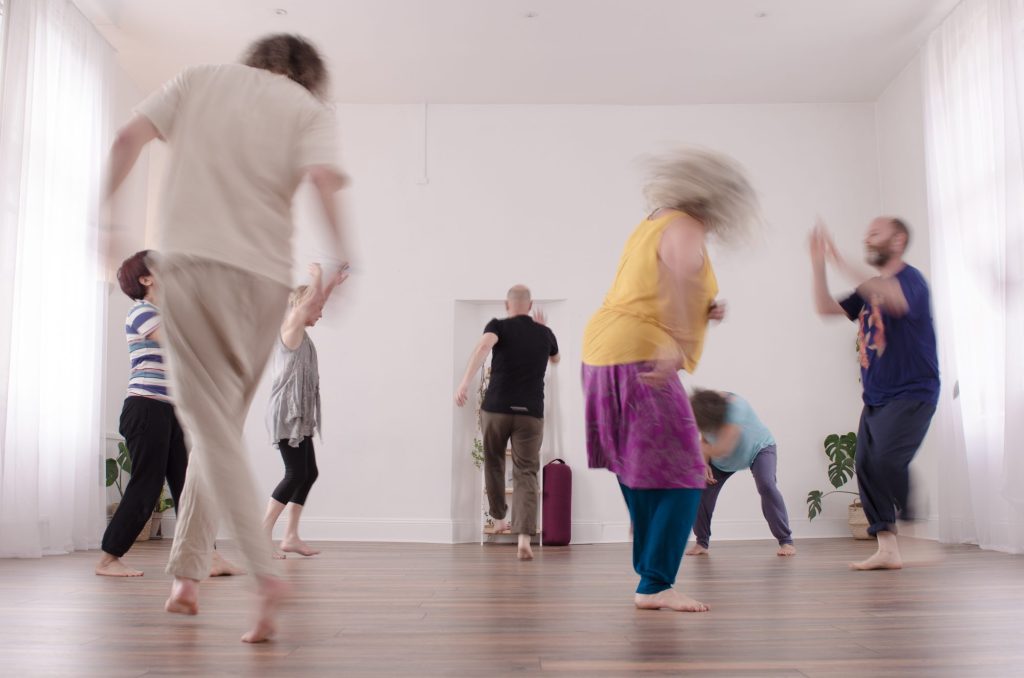
I have taught 5Rhythms® to children and teenagers, in hundreds of public classes, and to 100 mourners at the funeral of one of my students – including her 80-year-old father! It truly is accessible to anyone who wants to move and I always do my best to include differently abled bodies and minds in my classes. Very few people who come have formal dance experience, just a desire to move more freely and in community.
The ‘wave’ structure of the 5Rhythms® feels very natural, there are no steps to follow, and the focus is on how the movement feels rather than how it looks. Each person is unique and there is no way of getting it wrong because it’s your dance. Most people lose any self-consciousness in the warm up or early in the wave. Some occasionally take a little longer to feel safe. This is nothing to be concerned about. We can only let go as much as we can trust the process, the group and the teacher, and trust can take time to build. In the practice of showing up again and again we are increasingly able to surrender to our instinctive movement.
When we do this, the rewards can be transformative – a sense of liberation, deep processing and insights, and exquisite joy and connectedness. This work really does change lives. If you’re feeling anxious, it might help to have a little go at home. I have an introductory video that talks you through the wave so you can familiarise your body with the experience.
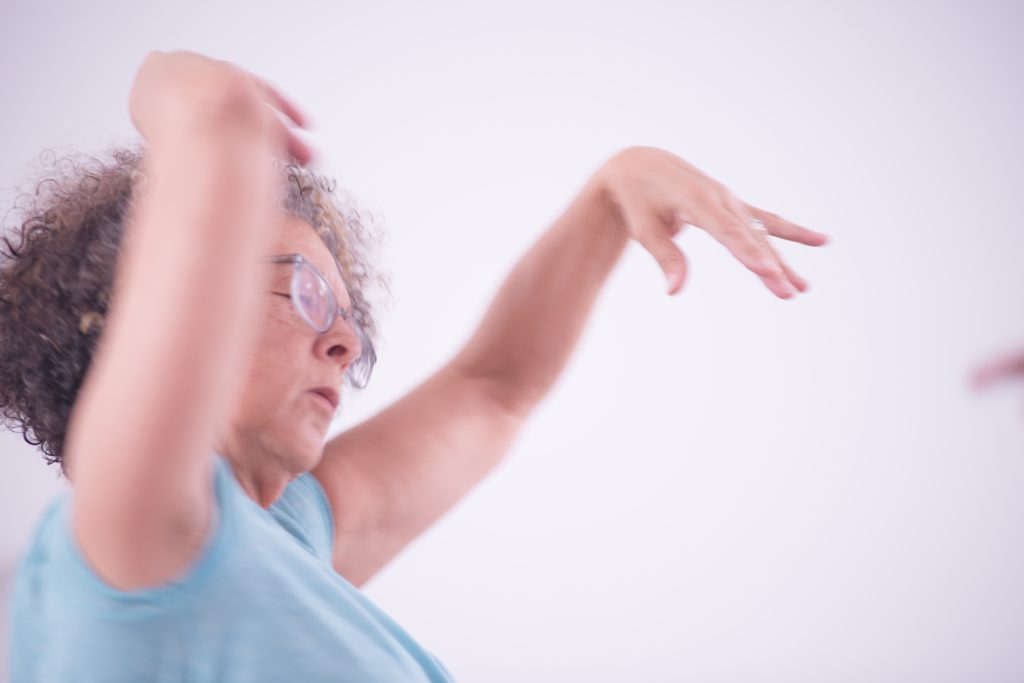
Don’t be surprised if emotions come to the surface. This is very common and always accepted if it comes up in a class. 5Rhythms® doesn’t specifically aim to stir people up but sometimes we have feelings bottled up or ready to overflow. They will move through if you allow your body to process them and you will feel different after.
Try to stay with the sensations and not get caught up in the stories – stories often trap us in our head trying to work things out. Bodies and emotions move more slowly than minds and it is important to allow them time – staying with embodied experience is the route to healing in this work. Gabrielle would always remind us not to push or hold back but rather notice how we are moved – on every level – with acceptance, interest and self-compassion.
It’s good for me to know if you have a history of trauma so I can work with you to create greater safety as needed.
There are lots of people facilitating sessions ‘inspired by 5Rhythms’, but only trained teachers are allowed to use this name. It is important to know your teacher is qualified, so do check!
It is totally possible to enjoy dancing with an untrained teacher, but it’s best to know what to expect both from them and yourself. If you just want to dance to feel looser and socialise, something like ecstatic dance or conscious clubbing will probably suit you fine. On the other hand, deeper process requires more holding. If you are going through a big transition or know you are carrying complex trauma, I recommend discernment.
Although teaching looks easy when it is done well, there is much more going on than there seems to be and there is potential for things to get challenging. Training prepares teachers to meet these challenges in a grounded way.
Teaching conscious movement is about being able to step aside and be present to allow something to come through you. Training, practice, and experience help cultivate the capacity for presence, in a variety of circumstances. Teachers need to learn to avoid getting caught up in ego when things heat up, handle power dynamics ethically, deal with being triggered by their students, and support dancers’ physical, mental and emotional safety. Potential trainees are required to complete hundreds of hours of practice to ensure they are familiar with their own habits, patterns, and triggers before being accepted. In the training itself they get to explore how these things show up in the unequal facilitator-dancer power dynamic.
Another thing to look for is how a teacher keeps their teaching up-to-date. How often do they dance in other teachers’ workshops? What other courses and trainings do they attend? Do they receive regular supervision?
If in doubt, check your teacher’s qualifications and experience, find out what several other dancers say about them, and if possible chat with them before your first class.

The core of the 5Rhythms® is the wave™ and this is easily recognisable in a class as the build up and release of energy which is generally clear in the music – starting slow, reaching a crescendo, and then settling. It might be taught through a combination of words, imagery, music, demonstration, and immersion.
The beauty of the wave is it’s deceptive simplicity. It’s basic structure can be learned, understood and applied in minutes, but the possibilities for exploration and discovery are endless.
Gabrielle never claimed to have created this structure. Rather, she uncovered it over time by observing people’s movement and articulating what she saw. She spent her whole life gradually refining 5Rhythms. Inspired by her own experience of an altered state she called the silver desert, her motivation was the desire to take others there.
Dancers often got in their own way and by tracking their internal obstacles Gabrielle created whole new workshops to help them through difficult territory: Heartbeat for moving the emotions, Mirrors for increasing awareness of the ego and putting it in service of the soul, Cycles for exploring the journey from birth to death, and God Sex and the Body for working with archetypes.
Other practices will not explicitly teach the rhythms, the wave™ or any 5Rhythms®-specific workshops, however because of their shared foundations, there may be similarities.
When I trained with Gabrielle in 2000 – 2001, she was supported by the core faculty of what was then the Moving Centre School: Andrea Juhan, Kathy Altman, Lori Saltzman, and Susannah and Ya’Acov Darling Khan. Since then The Moving Centre has been reimagined as 5Rhythms® Global, Susannah and Ya’Acov have created Movement Medicine, and Andrea, Kathy, Lori and others developed Open Floor. Other 5Rhythms® teachers have similarly developed their own particular flavour of movement practice for example: Amara Pagano’s Azul, Kate Shela 360 Emergence, Adam Barley’s Zero One, and Nele Vandezande and Cathy Ryan’s BISO. Other practices such as Soul Motion, Biodanza, and Freedom Dance have a different lineage. 5Rhythms® Global is now headed by Gabrielle’s son, Jonathan Horan. The International Conscious Movement Teachers Association is an umbrella organisation offering professional services to teachers from many of these schools.